
They’re not struggling because they’re lazy or because Chinese is beyond them. They’re struggling because nobody has shown them how the language actually works. They’ve been given lists to memorise and characters to drill, but never the logic underneath — never the reason why any of it is built the way it is.
Once you show them that logic, something shifts. The language stops feeling like a wall. They stop guessing and start reading. That shift is what I built Axis Chinese around.

Benjamin Lee Founder, Axis Chinese
Today, I work directly with Primary school students in small groups at Axis Chinese in Woodlands, helping English-dominant learners build clarity and confidence in Chinese through structured understanding rather than memorisation alone.
I didn’t come from teaching. I came from using Chinese.
My working life has been in business — and for a significant part of it, Chinese was not a subject I studied. It was a tool I used. Negotiations with suppliers in China. Commercial dealings where the other side expected precision and there was no room for approximation. You understand a language differently when it has to work under that kind of pressure. You stop thinking about it as a subject and start thinking about it as a system.
What that experience gave me is something I didn’t fully appreciate until I started working with students. I’m genuinely bilingual — not in a certificate sense, but in the way that matters for teaching. I can stand inside both languages at the same time. I can feel exactly where an English-dominant child’s mind is trying to cross into Chinese, and where that crossing breaks down. I can explain, in plain English, why a Chinese sentence is structured the way it is — and then show a child how to build one themselves.
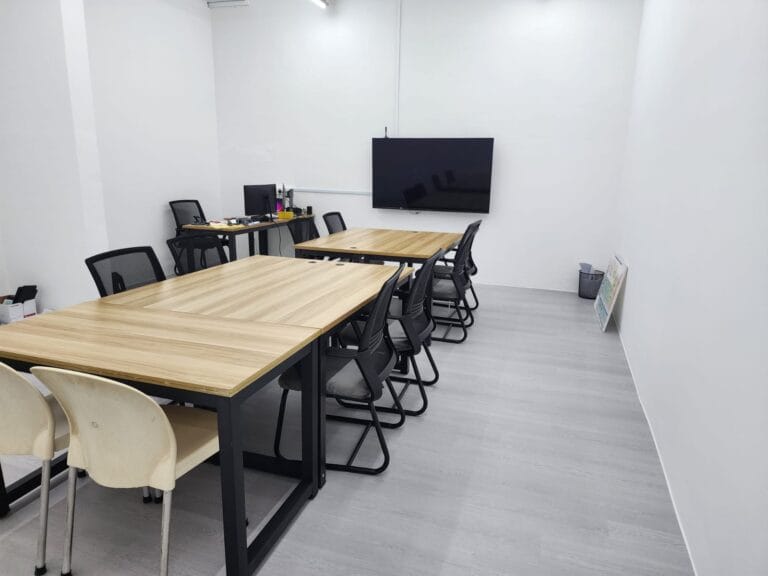
I keep Axis Chinese deliberately small. The method I use — Anchored Learning, built around Semantic DNA and Sentence Architecture — only works when I know each child specifically.
Six students per class, maximum. Not as a temporary measure — as a permanent one. This method only works if I know each child specifically. Not their level in general, but their particular gaps, the exact points where their understanding breaks down.
Every student begins with a diagnostic session before anything else. I’m not checking what they’ve memorised. I’m looking at how they currently process the language — where they can reason through something unfamiliar, and where they go blank. That becomes a one-page Student Logic Profile, and it shapes every lesson that follows.
You cannot do that work properly with twenty children in a room. So I don’t try.
I know what it costs to try something new after months of effort that hasn’t moved the needle. Not just the money — the hope. The conversations on the way home. The quiet watch for signs that something is finally different.
I will not waste that.
If I don’t think Axis Chinese is the right fit for your child, I’ll tell you before you commit. If something isn’t working, you’ll hear it from me first. That’s not a policy. It’s just how a small operation with a serious method has to conduct itself.
What I want you to know is this: the children I work with are almost never the problem. The method they’ve been given usually is. And that is a far more solvable thing than most parents realize when they first walk through the door.
Benjamin
Founder, Axis Chinese
Woodlands, Singapore
Not sure if this is right for your child? The diagnostic session answers that question — before you commit to anything.
Primary Chinese Tuition (P3–6)
Woodlands, Singapore
UEN: 53517860C
WhatsApp: +65 8587 3101
Email: axischinese@gmail.com
Blk 820 Woodlands St 82, #01-383, Singapore 730820
(Near Fu Shan Garden & Woodlands North Plaza)