
Primary Chinese Tuition · P3 and P4 · Woodlands
Your child isn’t struggling because they’re not trying. They’re struggling because nobody taught them the difference between memorizing Chinese and actually understanding it.
The way Chinese is being taught is changing. Rote memorization alone is no longer enough, and most children are caught in the gap between the old approach and what actually works.
Axis Chinese was built for exactly that gap.
We start with Primary 3 and 4. But we don’t stop there. The same method carries your child all the way to PSLE.
Start with a conversation. No commitment required.
Every week the spelling list gets studied. The 听写 comes back fine. Then the exam paper arrives…new sentences, unfamiliar contexts, questions that don’t look like anything they practiced, and the marks don’t follow.
This is not an effort problem. It is a method problem.
Rote memorisation builds a very specific skill: recognising what you have already seen. It does not build the ability to read something new, decode an unfamiliar character, or construct a sentence under pressure. And from Primary 4 onwards, that is exactly what the exam asks for.
The child who has only ever memorized has nothing to work with when the exam goes off script. And from Primary 4 onwards, it always does. They go blank, not because they are weak, but because nobody gave them a way to think it through.
That is the gap Axis Chinese closes.
Chinese was not built randomly. Every character has a reason. Every sentence follows a structure. Once a child can see that reason and that structure, the language stops being something they memorize and starts being something they can actually read.
This is what Anchored Learning is built around, two specific frameworks that give a child the tools to think through Chinese rather than just recall it.
Take the character 明.
Left side: 日 — the sun. Right side: 月 — the moon. Together: 明 — brightness, clarity.
Your child did not memorise that. They read it. The logic was already there — nobody had shown them how to look.
Every character carries this blueprint. Once a child learns to read it, an unfamiliar character is no longer a threat. It becomes a puzzle with a visible answer. That skill does not disappear

Most children write Chinese sentences by feel. They copy patterns they have seen before and hope the new sentence is close enough. When it isn’t, they guess.
Sentence Architecture gives a child a way to build a sentence they have never seen before and get it right. Not by feel. By logic. They stop guessing whether a sentence is correct and start building it deliberately.
This is where 造句 and 作文 marks are won or lost. Not in vocabulary. In structure.
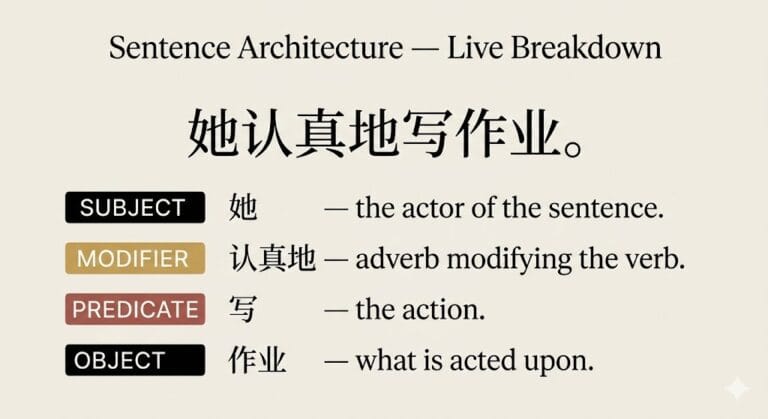
A note on this example — and a quick lesson.
Most children write 的 everywhere because nobody has shown them the difference. Here is the logic:
的 connects a describing word to a noun. 她的作业 — her homework. 的 links “her” to the thing she owns.
地 connects a describing word to a verb. 认真地写 — writes diligently. 地 links “diligently” to the action of writing.
得 comes after a verb to describe how well the action was done. 写得很好 — writes very well. 得 links the verb back to the quality of the result.
The pattern is simple once you see it: 描述东西用的. 描述动作用地. 描述结果用得. Describe a thing — 的. Describe an action — 地. Describe a result — 得.
This is Sentence Architecture in practice. Not a rule to memorize. A logic to apply. Once a child understands why each one exists, they stop guessing — and the marks follow.
Together, these two frameworks address the two places children lose marks most consistently — characters they don’t recognise and sentences they can’t construct.
The diagnostic session identifies exactly which of these gaps your child has, and where.
Their child stops leaving comprehension questions completely blank. They attempt them — not always correctly, but they have a way in now. Partial marks are still marks.
造句 and 作文 answers become more structured. Sentences are built deliberately rather than copied from memory and hoped for the best. Teachers start commenting that the writing is clearer.
Unfamiliar questions no longer produce a blank stare. The child has a way to approach something they haven’t seen before — and that skill shows up directly in the open-ended questions where most marks are actually won or lost.
The exam results start reflecting the work for the first time. Not because we drilled harder — because the foundation is now solid enough to hold under pressure.
These are not guarantees. Every child’s starting point is different. What we can tell you is that children who go through the diagnostic and follow the method consistently show up differently in exams — because they’re thinking through Chinese rather than trying to remember it.
Every class at Axis Chinese is capped at six students. Not as a policy — as a method requirement. Anchored Learning only works when the teaching responds to the specific child in front of it, not the average of a room.
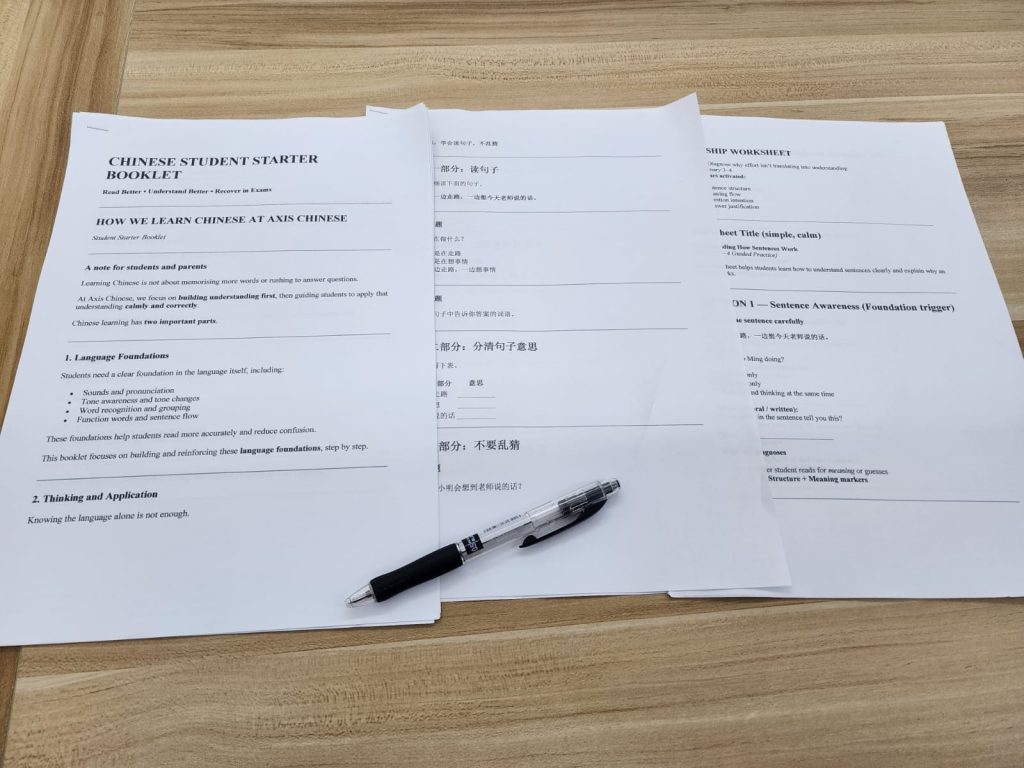
Every student begins with a Logic-Gap Diagnostic before anything else. A focused one-time session where we look at how your child currently processes Chinese — not what they’ve memorised, but where their understanding actually holds and where it breaks down. That becomes a one-page Student Logic Profile that shapes every lesson that follows.
Nothing here is generic. Nothing is filler. Every session is built around what your child specifically needs to anchor next.
And if after the diagnostic we don’t think Axis Chinese is the right fit — we’ll tell you honestly before you commit to anything.

Benjamin Lee Founder, Axis Chinese
I built Axis Chinese around a single observation; one I’ve seen consistently across the children I work with. The ones who struggle are rarely lazy or incapable. They’ve simply never been shown the logic the language runs on. Once they see it, everything changes.
I’m genuinely bilingual, not in a certificate sense, but in the way that matters for teaching. Chinese was my working language for years, used under real commercial pressure. That experience gave me an eye for exactly where an English-dominant child’s mind gets stuck crossing into Chinese and how to build the bridge across.
The teachers who struggle most to explain Chinese to English-dominant children are often the ones who know it best. When you’ve spoken a language your whole life, you stop being able to see where it breaks down for someone who hasn’t. The confusion becomes invisible to you.
I came to Chinese differently. I learned to use it as a working adult, under pressure, in situations where getting it wrong had real consequences. That means I remember exactly where the language stops feeling natural for an English-dominant mind. I remember the specific moments of confusion — and more importantly, I remember what finally made them click.
That’s what I bring into every lesson. Not mastery that forgot the struggle. Experience that remembers it.
We currently teach Primary 3 and 4 students. We start here because this is where most children either build a strong foundation — or miss it entirely. The children who struggle at PSLE Chinese usually started struggling here, in Primary 3 and 4, and nobody caught it in time.
The method we use doesn’t stop at Primary 4. As your child moves to Primary 5 and 6, we move with them. You won’t need to start over with someone new.
1 x 1.5hr lesson per week (4 lessons per month)
Small group learning (target max 6 students)
Monthly fee: $260/month
Diagnostic Lesson (Trial & Placement)
1 session (1.5 hours): $60
Includes assessment + feedback
Deposit
1-month deposit required to reserve a seat
Deposit will be used as the final month’s fee with proper notice (refer to Terms & Class Policy)
The $60 diagnostic fee is fully offset against your first month’s fees upon enrolment — so if you continue, the diagnostic costs you nothing extra.
Most centers focus on quantity—giving your child more lists to memorize. We focus on architecture. We teach the logical rules behind the language (Semantic DNA). Instead of memorizing 100 characters, your child learns the 5 radicals that unlock those 100 characters. We don’t drill; we decode.
That is exactly who this was built for. We call it the “Bilingual Bridge.” Because I come from a professional business background, I teach Chinese through a logical lens that English-dominant minds can actually process. We turn a “scary” subject into a predictable system.
This isn’t a “free trial” where your child sits in a corner. It is a 60-minute, 1-on-1 specialist audit. You receive a professional Student Logic Profile that identifies exactly where your child’s foundation is leaking. This $60 is a commitment to quality, and it is 100% credited back to your first month’s fees upon enrollment.
We value your time and honesty. If our group logic method isn’t the right tool for your child’s current level, we will tell you straight away. You still keep the Student Logic Profile report, which you can give to any future tutor to save them months of guesswork.
Yes. Lessons are structured, calm, and small-group.
We focus on reducing guessing and pressure, helping students rebuild confidence gradually.
Yes. While our method is unique, our content is 100% aligned with the latest MOE requirements. We use the syllabus vocabulary and exam formats, but we give your child the “structural map” to master them without the stress of rote memory.
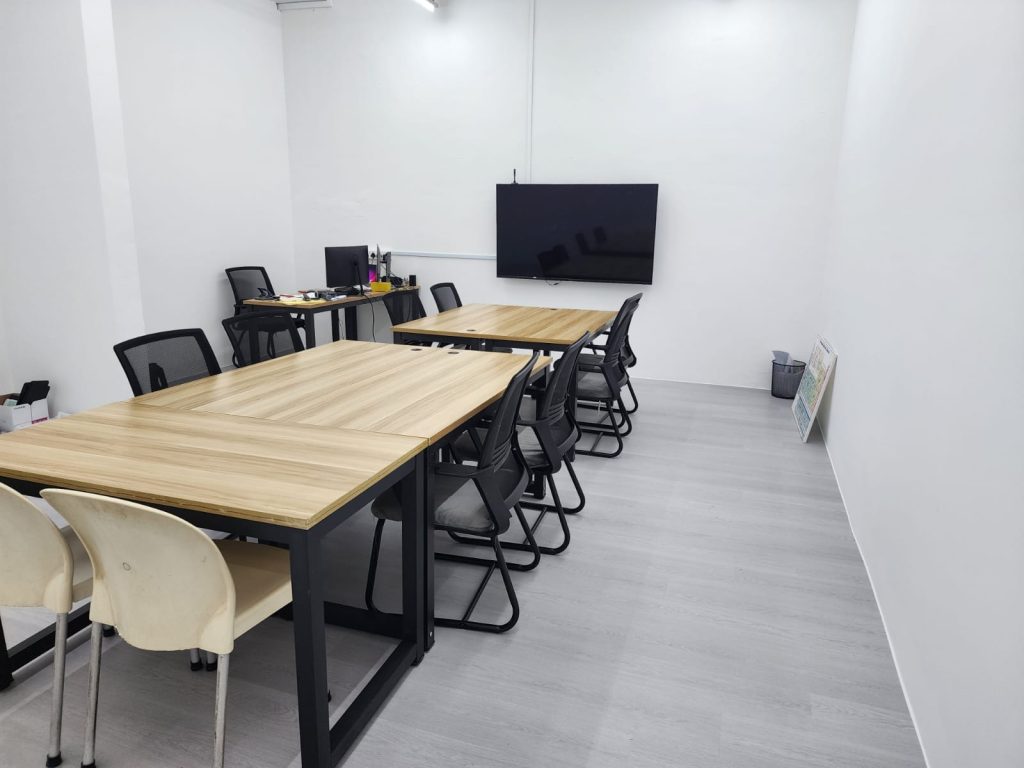
In-person, small-group classes in a quiet classroom setting.
Classes are conducted in person at:
Within APM Learning Centre
Blk 820 Woodlands Street 82
#01-383 Singapore 730820
Located within APM Learning Centre (quiet classroom environment)
That’s exactly what the diagnostic is for.
Start with a conversation. Tell us where your child is right now — what’s working, what isn’t, how long this has been going on. We’ll be straight with you about whether what we do is the right fit.
No pressure. No hard sell. Just an honest conversation about your child.
Primary Chinese Tuition (P3–4)
Woodlands, Singapore
UEN: 53517860C
WhatsApp: +65 8587 3101
Email: axischinese@gmail.com
Blk 820 Woodlands St 82, #01-383, Singapore 730820